
How Small Businesses Can Improve Their Google Rankings in 2026
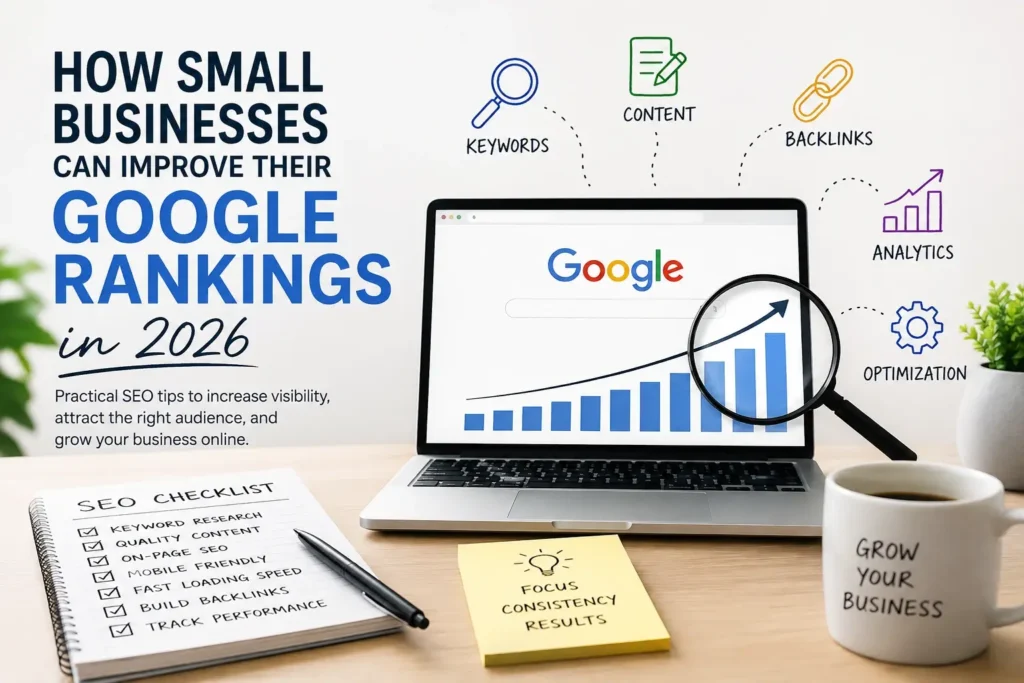
Small businesses looking to improve Google rankings in 2026 need to focus on useful content, strong SEO basics, and a website that gives visitors a good experience.
People usually turn to Google when they need a product, service, or solution. If your business does not appear when potential customers are searching, they may simply choose another company.
The good news is that you do not need a huge marketing budget to improve your visibility. SEO is often about making several small improvements consistently.
Here are some practical ways small businesses can strengthen their online presence and improve their search performance.
1. Understand What Your Customers Search For
SEO starts with understanding your audience.
Instead of choosing keywords only because they have a high search volume, think about what your potential customers would actually type into Google.
For example, someone may search for:
SEO services for small businesses
Freelance digital marketer
Website design services
Google Ads management
Social media marketing services
These searches show clear interest.
The goal is not to add as many keywords as possible. It is to choose keywords that closely match the services you provide.
Once you understand what people are searching for, you can create pages and content that answer those needs.
2. Make Your Website Easy to Understand
Your website should immediately explain what your business does.
A visitor should not need to scroll through several sections just to understand your services.
Your homepage should clearly explain:
What you offer
Who you help
Your main services
Why someone should choose you
How to contact you
Each service should also have enough information.
For example, instead of writing only:
SEO Services
you could explain what the service includes, such as keyword research, website optimization, content improvements, technical checks, and performance tracking.
Google also needs clear information to understand your website.
A simple, well-organized site is usually better than one filled with unnecessary text.
3. Create Content That Solves Real Problems
Blogging can help SEO, but only when the content has a purpose.
Publishing articles every day does not automatically mean your website will rank higher.
A better strategy is to answer questions your customers are already asking.
For example:
How can SEO help a small business?
Why is my website not appearing on Google?
SEO vs Google Ads: which is better?
How can I increase website traffic?
How often should I update my website?
How can a business get more local customers?
These topics have a clear purpose.
When someone finds your article useful, they may spend more time on your website, visit another page, or contact you for help.
Creating helpful content consistently is one of the best ways to improve Google rankings over time.
4. Use Your Focus Keyword Naturally
Keywords are still important, but they should never make your content difficult to read.
For example, if your target keyword is:
improve Google rankings
you do not need to repeat it in every paragraph.
Use it naturally in important places such as:
Page title
Main heading
Introduction
One or two subheadings
Meta description
Image alt text when relevant
A few places inside the content
Then use related terms naturally throughout the article.
This creates a better reading experience and gives search engines enough context to understand your topic.
5. Improve Your On-Page SEO
On-page SEO means optimizing the content and structure of individual pages.
Some simple areas to check include:
Page Title
Your page title should clearly explain the topic.
Avoid vague titles such as:
SEO Tips
A more useful title would be:
How Small Businesses Can Improve Google Rankings in 2026
Headings
Use headings to divide your content into clear sections.
This makes longer articles easier to read and helps visitors quickly find the information they need.
Meta Description
Write a short description that clearly explains what the page is about.
It should encourage people to click without making unrealistic promises.
URL
Keep your URL simple and readable whenever possible.
Short, descriptive URLs are easier for both visitors and search engines to understand.
6. Add Internal Links
Internal links connect one page of your website to another.
For example, if you write a blog about SEO, you can naturally link to your SEO service page.
If you discuss website performance, you could link to your website optimization or web design service.
Internal links can help visitors discover more useful information and help search engines understand how your pages are related.
Do not add links just for the sake of adding them.
Use them when they genuinely help the reader.
7. Make Sure Your Website Works Well on Mobile
Many people search on their phones.
A website that works perfectly on desktop may still be difficult to use on mobile.
Check:
Text size
Menu navigation
Contact buttons
WhatsApp buttons
Forms
Images
Page spacing
Loading speed
Always test your website on an actual phone.
If visitors struggle to use your site, they may leave before taking any action.
SEO should not only bring people to your website.
Your website should also make it easy for them to contact you.
8. Improve Website Speed
Page speed affects the overall user experience.
Large images, unnecessary plugins, heavy animations, and poorly optimized pages can slow down a website.
A few simple improvements include:
Compress images before uploading them
Use WebP images when possible
Remove plugins you no longer use
Avoid uploading extremely large photos
Use caching
Keep page designs simple
You do not need to remove every visual element.
The goal is to find a balance between design and performance.
9. Keep Your Google Business Profile Updated
For businesses that serve customers locally, Google Business Profile is an important part of online visibility.
Make sure your information is accurate.
Check:
Business name
Website
Phone number
Business hours
Services
Category
Photos
Business description
You can also add regular updates and respond to reviews.
A complete profile gives potential customers more confidence when they find your business through Google.
10. Build Relevant Backlinks
Backlinks are links from other websites pointing to your site.
They can support SEO, but quality matters much more than quantity.
Avoid creating hundreds of links on unrelated or low-quality websites.
Instead, focus on relevant opportunities such as:
Professional profiles
Business directories
Industry websites
Guest articles
Content publishing platforms
Relevant communities
Business mentions
A useful backlink should make sense.
If a website has nothing to do with your industry or audience, the link may not provide much value.
11. Build Trust With Reviews
Reviews can influence whether someone chooses to contact a business.
Encourage genuine customers to share their experience.
Do not buy fake reviews.
A smaller number of genuine reviews is much better than a large number of suspicious ones.
Reply professionally when someone leaves feedback.
A simple response shows that you are active and value your customers.
12. Track Your Performance
SEO should not be based on guessing.
Use tools such as Google Search Console and Google Analytics to understand how your website is performing.
You can monitor:
Impressions
Clicks
Search queries
Website visitors
Popular pages
Engagement
Conversions
Do not focus only on your ranking position.
A page can move up and down regularly.
Instead, look at the overall trend.
Ask:
Are more people finding my website?
Are impressions increasing?
Are visitors clicking important pages?
Are people submitting forms or contacting me?
These are stronger indicators of whether your SEO strategy is working.
13. Update Existing Content
You do not always need to publish something new.
Older pages can become more useful when they are updated.
Review your existing content and check for:
Outdated information
Weak headings
Missing internal links
Broken links
Old images
Poor meta descriptions
Pages with very little useful information
Updating an existing article can sometimes be just as valuable as creating a new one.
14. Stay Consistent
SEO takes time.
One blog, one backlink, or one optimization will rarely change everything overnight.
Results usually come from consistent work.
Continue improving your pages.
Publish useful content.
Build relevant links.
Improve website performance.
Track your results.
Then adjust your strategy based on what you learn.
The businesses that stay consistent usually build a stronger online presence over time.
Final Thoughts
There is no single shortcut to improve Google rankings.
Strong SEO is usually the result of several things working together: useful content, clear website structure, relevant keywords, quality backlinks, good user experience, and consistent improvements.
Start with the areas that need the most attention.
Improve one page.
Publish one useful article.
Fix one website issue.
Build one relevant backlink.
Then continue.
Small improvements can create meaningful results when they are done consistently.
If you need support with SEO, Google Ads, Social Media Marketing, Website Optimization, Web Design, or E-commerce, you can learn more here: